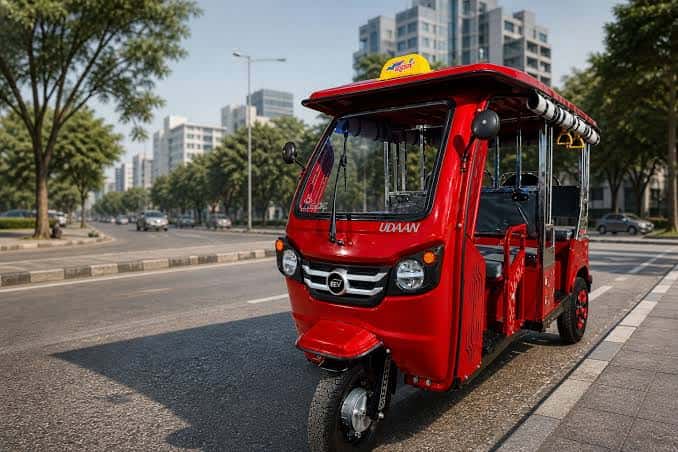
India runs the world’s largest electric rickshaw market — nearly two-thirds of global electric three-wheeler trade happens right here, with drivers reporting savings of 60-70% on daily running costs compared to conventional autos. What started as a grassroots, informal shift on city streets has now become a genuine industrial sector valued at over $1.6 billion, growing at a robust 14% annually, with established automakers and dedicated EV specialists competing intensely for a market that’s expanding well beyond metro cities into towns and villages.
| Rank | Company | Known For | Positioning |
| 1 | Mahindra Electric | R&D-driven, safety & durability focus | Leading OEM, wide “tempo” and rickshaw range |
| 2 | YC Electric Vehicles | Frequently tops Vahan volume charts | Budget-conscious owner-drivers, strong North India presence |
| 3 | Saera Electric Auto (Mayuri) | One of India’s first e-rickshaw makers | Established brand trust, wide dealer network |
| 4 | Kinetic Green | Innovation and design-focused | Comfort and modern styling |
| 5 | Piaggio Vehicles | Decades of engineering heritage | Stable, strong-ride models for city and rural use |
| 6 | Bajaj Auto (RE EV / Riki) | Late entrant, feature-heavy vehicles | GoGo electric auto range, Bajaj Riki e-rickshaw |
| 7 | J.M.T Vehicles | Fast-rising, practical Indian-road design | Commercial vehicle efficiency focus |
| 8 | Terra Motors India | Established EV manufacturer | Passenger and cargo variants |
| 9 | Seth Industrial Corporation (SIC) | Rickshaw kit industry pioneer since 1964 | 80%+ market share in rickshaw kits |
| 10 | Bahubali E Rickshaw | Strong build quality, dedicated service | Affordable transport, growing service network |
1. Mahindra Electric – The Established Market Leader
Mahindra Electric is widely regarded as the leading electric vehicle business among e-rickshaw manufacturers, backed by years of dedicated research and development.
- Offers a wide range of electric “tempos” and rickshaws, benefiting from dependable lithium battery options and high consumer trust.
- Their electric rickshaws emphasize safety, technology integration, and genuine long-term durability.
- The Mahindra Treo Plus specifically stands out in the broader electric auto-rickshaw segment for its combination of range, reliability, and ownership confidence.
2. YC Electric Vehicles – The Volume Leader for Owner-Drivers
YC Electric was among the first e-rickshaw manufacturers in India and continues showing strong registration-based leadership.
- Vahan-based monthly reporting consistently shows YC Electric near the top of e-rickshaw volume charts, reflecting genuine scale advantage.
- Popular models like Yatri Deluxe and Yatri Super offer simple, no-nonsense electric mobility for passengers and small cargo loads.
- Particularly strong presence and reputation across North India specifically.
3. Saera Electric Auto (Mayuri) – The Established Trust Brand
Saera Electric Auto, known by its Mayuri brand, is one of the first e-rickshaw makers in India and continues holding genuine brand loyalty.
- Also manufactures e-cargo loaders, e-golf carts, and two-wheelers under its YOGO brand, diversifying beyond passenger rickshaws alone.
- Operates multiple manufacturing plants across India, giving it a long history and proven reliability that buyers specifically value.
- Vehicles are known for comfortable seating, solid battery performance, and easy maintainability.
4. Kinetic Green – The Design-Forward Innovator
Kinetic Green has positioned itself as a modern electric rickshaw specialist focused on innovation and environmentally friendly transportation.
- Products attract buyers who specifically value comfort combined with modern design and performance.
- Continues building a reputation for highly efficient, practical electric vehicles beyond just rickshaws.
5. Piaggio Vehicles – The Engineering Heritage Player
Piaggio brings decades of experience, reliable build quality, and genuine flexibility to India’s e-rickshaw segment.
- Their e-rickshaws provide a stable, strong ride capable of handling both crowded city streets and rural lanes.
- Benefits from Piaggio’s broader three-wheeler engineering legacy, translating into genuine mechanical reliability.
6. Bajaj Auto – The Feature-Heavy Late Entrant
Bajaj Auto entered the electric three-wheeler space more recently but has moved aggressively to establish presence with feature-rich vehicles.
- Launched the GoGo electric auto range in February 2025, followed by a dedicated e-rickshaw entry, Bajaj Riki, in November 2025.
- The Bajaj RE EV is positioned as the ideal choice for owner-drivers transitioning from conventional compressed natural gas autos.
- If fleet buyers consolidate vendors around trusted, established brands, Bajaj’s scale and dealer network could help it win multi-city rollouts quickly, though ramping service support for a newer portfolio remains a genuine execution challenge.
7. J.M.T Vehicles – The Fast-Rising Practical Specialist
J.M.T Vehicles Private Limited has gained significant popularity as one of the fastest-rising EV manufacturers specifically in the e-rickshaw category.
- Designs highly practical vehicles engineered specifically for Indian road conditions.
- Specializes in commercial vehicle manufacturing with a strong focus on performance and operational efficiency.
8. Terra Motors India Corp.
Terra Motors India stands among the established major companies operating in India’s electric rickshaw market.
- Offers both passenger and cargo electric rickshaw variants, serving diverse commercial and personal transport needs.
9. Seth Industrial Corporation (SIC) – The Rickshaw Kit Pioneer
Seth Industrial Corporation, established in 1964, is a genuine pioneer and market leader specifically in the rickshaw kit industry.
- Holds over 80% market share in the rickshaw kit segment, a remarkably dominant position within its specific niche.
- Long-standing manufacturing history gives it deep credibility among component buyers and small-scale assemblers.
10. Bahubali E Rickshaw
Bahubali E Rickshaw has built recognition specifically for strong build quality, powerful motors, and a dedicated customer service network.
- Positioned as an affordable electric mode of transport, appealing to cost-conscious buyers and fleet operators alike.
- Continues expanding its service reach to support the durability and after-sales expectations of its growing customer base.
What’s Driving This Industry’s Explosive Growth
- Government incentive continuity — the extended FAME-II program alongside the Electric Mobility Promotion Scheme 2024 keeps per-vehicle subsidies intact, lowering acquisition costs for drivers outside major metros.
- State-level top-ups, including purchase rebates and road-tax waivers in Maharashtra, Karnataka, and Delhi, stack further savings, making electric three-wheelers genuinely price-competitive with conventional models.
- Expansion beyond Tier-I metros into Tier-II and Tier-III towns is widening the addressable market considerably, supported by battery chemistry advances and modular finance models.
- Upcoming regulatory changes — India’s draft policy direction points toward stronger safety controls, speed caps, and manufacturing audits starting April 1, 2026, alongside tighter battery standards, which will likely reward manufacturers already investing in quality and compliance.
The Bottom Line
India’s electric rickshaw industry combines established automotive giants like Mahindra and newly entering Bajaj with dedicated EV specialists like YC Electric, Saera (Mayuri), and Kinetic Green, together serving a market valued at over $1.6 billion and projected to double by 2031. With government subsidies, expanding rural and semi-urban demand, and tightening safety regulations all converging, the manufacturers investing early in quality, service networks, and compliance are best positioned to lead India’s continued electric three-wheeler dominance globally.
FAQs
Q1. Which e-rickshaw manufacturer currently leads in actual sales volume?
YC Electric frequently tops Vahan-based monthly registration data, showing strong scale advantage among cost-focused owner-drivers.
Q2. Is Bajaj Auto a reliable choice given its recent entry into e-rickshaws?
Bajaj brings strong brand trust and dealer network, though its e-rickshaw portfolio is newer and service ramp-up remains a factor to watch.
Q3. What upcoming regulations should e-rickshaw buyers be aware of?
India’s draft policy tightens safety controls, speed caps, and battery standards starting April 1, 2026, affecting manufacturing audits.
Q4. Why is India considered the global leader in electric rickshaws specifically?
Nearly two-thirds of worldwide electric three-wheeler trade happens in India, driven by strong domestic demand and government incentives.