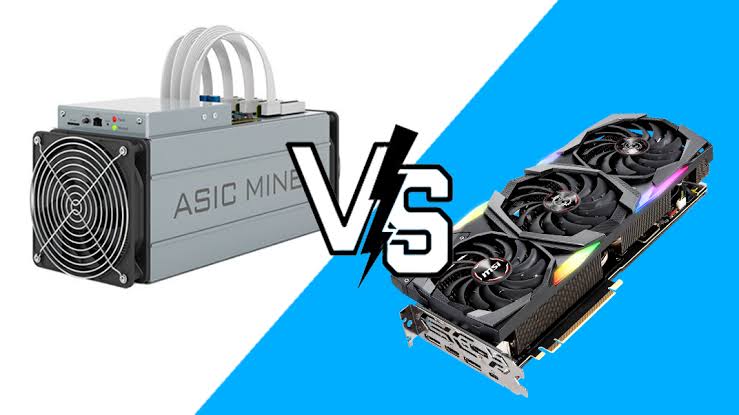
ASIC vs GPU mining hardware differs so dramatically that comparing them almost feels unfair once you see the actual numbers side by side. One is a general-purpose chip originally built for rendering video game graphics, repurposed for mining as a side use. The other is a piece of silicon designed from the ground up to do exactly one mathematical task, and nothing else, as efficiently as physically possible. That difference in philosophy explains nearly every practical trade-off between the two.
| Quick Facts | Details |
| ASIC meaning | Application-Specific Integrated Circuit — built for one algorithm only |
| GPU meaning | Graphics Processing Unit — general-purpose hardware adapted for mining |
| Typical ASIC lifespan before obsolescence | 12-18 months |
| Typical GPU lifespan | 3-5 years, with resale value beyond mining |
| Coins ASICs dominate | Bitcoin and other SHA-256 based chains |
| Coins GPUs remain viable for | Ergo, Ravencoin, Kadena, Flux, Ethereum Classic, and other ASIC-resistant algorithms |
Here’s a number that puts the entire comparison into perspective: a high-end gaming GPU like the RTX 4090 produces roughly 2 gigahashes per second on Bitcoin’s SHA-256 algorithm. A dedicated ASIC like the Bitmain Antminer S21 XP produces 270 terahashes per second — approximately 135,000 times more hashing power from a single unit. At current network difficulty, the most powerful consumer GPU available today would take over 100 years to mine a single Bitcoin block on its own. That gap isn’t a minor performance difference — it’s the reason GPU Bitcoin mining has become essentially impossible at any meaningful scale.
Why the Hashrate Gap Is So Extreme
Understanding the architecture explains why this gap exists and why it can’t realistically close.
- A GPU is designed to handle thousands of different tasks — graphics rendering, general computing, floating-point math — spreading its circuitry across many capabilities
- When a GPU mines, it’s using only a small fraction of its total silicon for the actual hashing work, wasting energy on components that contribute nothing to mining
- An ASIC dedicates every single circuit, every design decision, exclusively to solving one specific algorithm, with zero wasted capability
- This specialization is precisely why ASICs achieve such extreme efficiency advantages — there’s no general-purpose overhead diluting their output
- The trade-off is equally extreme in the other direction: an ASIC can only ever mine the one algorithm it was built for, permanently
Which Coins Each Hardware Type Can Actually Mine
The practical choice between ASIC and GPU depends entirely on which cryptocurrency you’re targeting.
- Bitcoin and other SHA-256 chains — ASICs are the only realistic option; GPU mining here is a guaranteed financial loss
- Ethereum Classic (ETC) — remains GPU-mineable through the Ethash algorithm, since the original Ethereum’s 2022 switch to Proof-of-Stake left ETC as the primary chain still using this GPU-friendly method
- Ergo, Ravencoin, Kadena, Flux — all maintain GPU-friendly algorithms specifically to resist ASIC dominance
- Monero — uses RandomX, an algorithm deliberately engineered to favor regular CPUs over both ASICs and GPUs, prioritizing network decentralization
- Early-stage altcoins occasionally offer brief windows of GPU profitability before dedicated ASIC hardware eventually gets developed for them
Cost, Efficiency, and Break-Even Electricity Rates
| Factor | ASIC | GPU |
| Typical upfront cost | $3,000–$6,000+ per unit | $1,500–$2,000 per high-end card |
| Break-even electricity rate | Roughly $0.05–$0.11 per kWh | Roughly $0.04 per kWh for viable altcoins |
| Suitable for Bitcoin mining | Yes, the only practical option | No, not at any meaningful scale |
| Suitable for altcoin mining | Limited to specific supported coins | Yes, across many ASIC-resistant coins |
| Flexibility to switch coins | None — permanently locked to one algorithm | High — can switch based on profitability |
Resale Value and Hardware Lifespan
This is where the long-term economics genuinely diverge, beyond just day-to-day mining output.
- ASIC manufacturers release new, more efficient models roughly every 6 months, meaning a purpose-bought ASIC often becomes uncompetitive within 12-18 months
- Once an ASIC becomes obsolete, there’s no meaningful upgrade path — the chip physically cannot be improved through software or firmware alone
- An obsolete ASIC has essentially no alternative use case beyond mining, often ending up as electronic waste
- GPUs, by contrast, typically remain useful for 3-5 years and retain resale value even after mining stops being profitable, since they can be repurposed for gaming, video rendering, or increasingly, AI compute workloads
- That said, the practical resale argument has weakened somewhat in 2026 — a flood of used cards from failed mining operations has depressed secondary market prices for GPUs specifically bought for mining
Noise, Heat, and Practical Setup Considerations
Beyond pure economics, the physical experience of running each type of hardware differs considerably.
- ASICs are genuinely loud, generally unsuitable for a home or apartment setting without dedicated soundproofing or a separate facility
- GPU rigs run considerably quieter, though a large multi-card setup can still generate meaningful noise and heat
- Modern hydro-cooled ASIC deployments can actually operate at lower thermal density than equivalent GPU clusters at industrial scale, reducing facility cooling costs for large operations
- GPU rigs involve more setup complexity — driver configuration, riser cables, and multiple points of potential hardware failure across an eight-card rig
- ASICs are largely plug-and-play once configured, with fewer individual failure points, though a failure typically means the entire unit is down rather than a single component
Choosing Between ASIC and GPU: A Decision Framework
Rather than a universal “better” answer, the right choice depends on specific goals and constraints.
- Choose ASICs if your primary goal is mining Bitcoin specifically, you have access to genuinely cheap electricity, and you’re comfortable with hardware that depreciates quickly
- Choose GPUs if you want flexibility to switch between altcoins as profitability shifts, value hardware that retains use beyond mining, or you’re starting out and want to learn mining mechanics without a large upfront commitment
- If you already own a high-end GPU for gaming or creative work, mining an ASIC-resistant altcoin during idle hours can generate modest supplemental returns
- Buying a GPU specifically and exclusively to mine Bitcoin is a financial mistake at current network difficulty, regardless of how the hardware is marketed
- Calculate your actual electricity rate against current profitability calculators before committing to either path — this single number determines whether either approach makes financial sense at all
This is general educational information about mining hardware, not financial or investment advice. Mining hardware profitability changes with market conditions, network difficulty, and electricity costs, and independent research before any significant purchase is a reasonable precaution.
FAQs
Q1. Can a powerful gaming GPU mine Bitcoin profitably in 2026?
No. Even a high-end GPU like the RTX 4090 would take over 100 years to mine a single Bitcoin block at current network difficulty, making it entirely impractical compared to dedicated ASIC hardware.
Q2. Why do ASICs become obsolete so much faster than GPUs?
ASIC manufacturers release more efficient models roughly every 6 months, and since an ASIC can’t be upgraded through software, older units quickly fall behind newer, more power-efficient competitors.
Q3. Which cryptocurrencies can still be mined profitably with a GPU?
Coins using ASIC-resistant algorithms — including Ethereum Classic, Ravencoin, Ergo, and Kadena — remain viable for GPU mining, unlike Bitcoin, which requires dedicated ASIC hardware.
Q4. Do GPUs really hold their value better than ASICs after mining becomes unprofitable?
Generally yes, since GPUs can be repurposed for gaming, rendering, or AI workloads, though a market flooded with used mining cards has reduced resale prices somewhat in 2026.
Q5. What electricity rate do I need for ASIC mining to be profitable?
Most current-generation ASICs require electricity priced below roughly $0.08-0.11 per kWh to remain reliably profitable, well below typical residential rates in most countries.