Buying a home in India has historically been an act of considerable faith. Before 2017, a buyer who signed a builder-buyer agreement had few enforceable rights. Developers collected money on the promise of possession by a certain date, then delayed projects by two, three, or five years without penalty. Carpet area was measured in ways that varied conveniently from one project to the next. Advertising made promises about amenities, specifications, and distances that were legally meaningless once the money changed hands. And when disputes arose, buyers had to navigate the Consumer Forum’s lengthy proceedings — cases that took years to reach resolution while EMIs continued and construction stood still.
The Real Estate (Regulation and Development) Act, 2016 — universally known as RERA — changed this framework in the most comprehensive legal overhaul India’s real estate sector has ever seen. Enforced from May 1, 2017, the Act created statutory protections that shifted the balance of power from developers toward buyers in ways that simply did not exist before. Understanding RERA in its full detail is not optional knowledge for anyone buying property in India today. It is the foundational literacy that separates informed buyers from vulnerable ones.
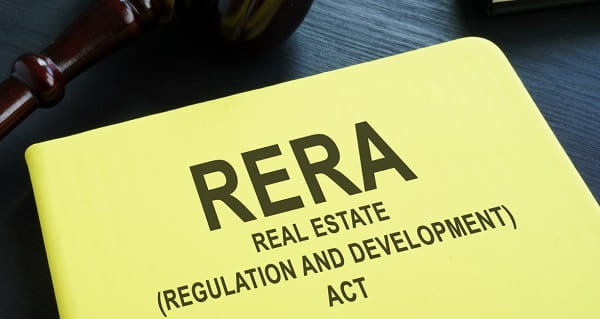
What RERA Is and How It Works
RERA is a Central Act that establishes a regulatory framework for India’s real estate sector. Under it, every state and union territory is required to create a Real Estate Regulatory Authority — a state-level body that registers projects and agents, monitors compliance, receives and adjudicates buyer complaints, and issues binding orders against developers who violate the Act’s provisions. States must also establish a Real Estate Appellate Tribunal to hear appeals against Authority orders.
Every residential project exceeding 500 square metres of construction area or involving more than eight units, and every commercial project above 500 square metres, must be registered with the state RERA before any marketing, advertising, booking, or collection of money begins. This registration requirement is the Act’s foundational provision — a developer who collects a single rupee as a booking amount for an unregistered qualifying project is in direct legal violation.
Real estate agents who facilitate transactions in RERA-registered projects must also be registered with the state Authority. An agent who is not registered cannot legally operate in this space, and their involvement in a transaction exposes both the agent and their clients to regulatory risk.
The Seven Core Protections RERA Creates
Mandatory project disclosure is the first and most practically immediate protection. When a developer registers a project with RERA, they must upload to the state portal a complete set of disclosures — the approved layout plan, the sanctioned building plan, the names of the structural engineer and architect, the total number of units, the declared completion date, the status of all required government approvals, and the financial details of the project. This information is publicly accessible to any buyer without any fee or registration requirement. For the first time, the information asymmetry that had always favoured developers was formally addressed.
The 70 percent escrow rule is perhaps the most financially significant protection in the Act. Developers must deposit 70 percent of all money collected from buyers into a dedicated project-specific bank account. This money can only be withdrawn in proportion to verified construction progress — certified jointly by an engineer, an architect, and a chartered accountant. The rule was designed to prevent the most common form of developer malpractice: collecting buyer money for Project A and diverting it to purchase land for Project B, or to service existing debt. Before RERA, this diversion was common and essentially unchecked. Today, it is a regulated withdrawal system that banks and state authorities monitor.
Carpet area standardisation removed one of real estate’s most persistent consumer deceptions. Before RERA, developers quoted built-up area or super built-up area — figures that included walls, lift lobbies, common passages, staircases, and sometimes even portions of external corridors — and priced per square foot on these inflated numbers. A buyer who thought they were buying 1,200 square feet might be receiving 780 square feet of actual usable floor space. RERA mandates that all pricing must be quoted on carpet area — defined precisely as the net usable floor area within the walls of the apartment — and any deviation between promised and delivered carpet area beyond permitted tolerance must be compensated.
Legally binding delivery timelines ended the era of consequence-free delays. Developers must commit to a completion date at registration. If possession is delayed, buyers are entitled to receive interest on their paid amounts at the SBI MCLR plus 2 percent rate for every month of delay — or to exit the project entirely and receive their full money back with interest. This penalty mechanism, combined with the public visibility of project timelines on RERA portals, has meaningfully changed developer behaviour on delivery.
Advertising accountability means that every representation made in a developer’s advertisement, brochure, or sales pitch — whether a swimming pool, a clubhouse, a specific view, or a school nearby — forms part of the legal agreement with the buyer. A developer who advertises amenities they do not deliver faces regulatory action. RERA registration numbers must appear on all advertising materials, enabling buyers to cross-reference claims against the registered project details.
Structural defect liability requires developers to rectify any structural defect that appears within five years of possession, at their own cost and within 30 days of notice. This is a meaningful protection that addresses construction quality failures that only become apparent after move-in.
Agent accountability brings the intermediary layer — previously entirely unregulated — into the formal accountability framework. Registered agents cannot facilitate transactions in unregistered projects, must maintain prescribed conduct standards, and can be penalised for violations.
The Complaint and Adjudication System
When a developer violates any RERA provision — delayed possession, changed specifications, undelivered amenities, or registration non-compliance — a buyer can file a complaint directly on the state RERA portal. The complaint is allocated to an adjudicating officer who must decide the matter within 60 days. Orders are binding on the developer and can require refunds, interest payment, penalty, or specific performance of the developer’s obligations.
If a developer fails to comply with an Authority order, the Authority can issue a revenue recovery certificate — treated as arrears of land revenue — enabling recovery from the developer’s assets. Repeated or serious violations can result in penalties of up to 10 percent of the project cost and, in the most extreme cases, imprisonment of up to three years for the developer.
For buyers who are unsatisfied with the Authority’s adjudication, the Real Estate Appellate Tribunal provides the next level of recourse, with High Court appeals available thereafter.
RERA’s Evolution — What Has Changed Since 2017
RERA at nine years of implementation has produced meaningful outcomes. Project delays have reduced measurably in RERA-compliant markets. Transparency through state portals has improved dramatically — Maharashtra’s MahaRERA, Tamil Nadu’s TNRERA, and Gujarat’s GUJRERA have built comprehensive digital infrastructure that provides quarterly progress reports with verified photographs, financial compliance tracking, and complaint resolution dashboards accessible to any buyer from their phone.
The framework continues evolving. MahaRERA introduced AI-driven project monitoring in 2025, with construction photographs verified against declared progress percentages. QR codes on all real estate advertising materials — now mandatory in several states — link directly to the project’s RERA registration page, making verification as simple as a phone scan. In early 2026, RERA’s scope was under consideration for extension to rental housing and commercial leasing in several states, widening its consumer protection reach.
What RERA Cannot Do — Understanding the Limits
RERA’s protections exist only for projects that are registered. Unregistered projects — which include plots below the threshold size, renovations, standalone commercial units in some states, and illegal developments — fall entirely outside RERA’s protective umbrella. Buyers in unregistered projects have only the Consumer Forum and civil courts as recourse, reverting to pre-RERA conditions.
Additionally, RERA’s practical effectiveness varies significantly by state. Maharashtra, Gujarat, Karnataka, and Tamil Nadu have the most actively administered RERA authorities with strong digital infrastructure. Some northern states and smaller UTs have been slower to build effective enforcement mechanisms, creating a two-tier system where the law’s protections exist formally but enforcement remains inconsistent.
The Single Most Important RERA Habit for Every Buyer
Before paying a single rupee as a booking amount, go to the state RERA portal. Search for the project by name or developer name. Verify that the RERA registration number displayed in the brochure matches an active registration. Check the complaints tab for any prior disputes against the developer. Look at the quarterly progress reports to verify that physical construction matches declared financial withdrawals. These five steps, taking perhaps 20 minutes, represent the most valuable pre-purchase due diligence a buyer can perform.
RERA gave Indian homebuyers rights they did not previously have. The buyers who benefit most from those rights are the ones who know what they are and use them proactively.
FAQs
Q: What is RERA and when did it come into effect?
A: RERA stands for the Real Estate (Regulation and Development) Act, 2016. It came into force on May 1, 2017, establishing regulatory authorities in every Indian state to protect homebuyers, register projects and agents, and adjudicate disputes.
Q: Does RERA apply to all property purchases in India?
A: RERA applies to residential and commercial projects exceeding 500 square metres or more than eight units. Smaller projects, individual resales, land transactions, and unauthorized constructions fall outside RERA’s scope.
Q: What is the 70 percent escrow rule under RERA?
A: Developers must deposit 70 percent of all buyer collections into a dedicated project bank account, withdrawable only against verified construction milestones certified by an engineer, architect, and chartered accountant. This prevents fund diversion to other projects.
Q: Can I get a refund if my builder delays possession?
A: Yes — under RERA, a delayed developer must either pay interest at SBI MCLR plus 2 percent per month for the period of delay or provide a full refund with interest if the buyer chooses to exit the project.
Q: How do I file a RERA complaint against a builder?
A: Visit your state’s official RERA portal, register as a complainant, and file an online complaint with supporting documents and evidence. The Authority must adjudicate within 60 days and the order is binding on the developer.