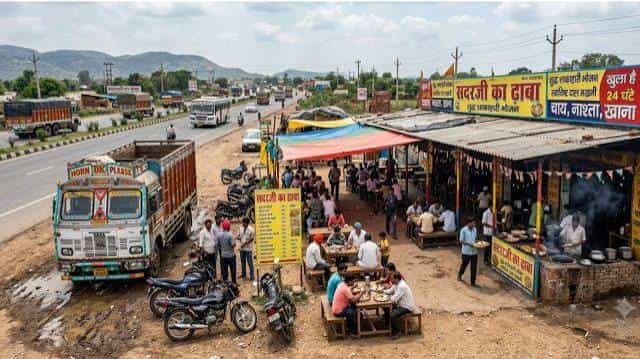
Is a dhaba business legal in India? It can be — fully, cleanly legal — but 2026 has turned into a genuinely risky year for dhaba owners who never checked whether their land itself is legitimate. Licensing alone won’t save a dhaba built on the wrong side of a highway boundary right now, because courts and highway authorities have started treating location as seriously as food safety compliance.
That’s a real shift from how this business has traditionally operated. For decades, dhabas sprang up along national highways with little more than a rented patch of land and a tandoor. Many still operate exactly that way. But a wave of Supreme Court directions and NHAI enforcement drives through 2026 has made it clear: a dhaba can hold every food license in the book and still face demolition if it’s sitting inside a highway’s protected zone.
The Land Question Now Matters More Than Any License
This is the part most dhaba guides skip entirely, and it’s arguably the most consequential issue facing highway dhabas right now. In 2026, the Supreme Court took up highway safety concerns directly, after fatal accidents were linked to unregulated dhabas built too close to the road edge, with vehicles stopping abruptly to reach them. The Court noted that many of these establishments sit on land that was never officially notified for commercial use in the first place.
Following that, states have moved fast:
- Maharashtra ordered district magistrates to demolish illegal dhabas and commercial structures within the Right of Way of national highways within 60 days, and directed that no license or NOC be granted for sites inside highway safety zones without prior NHAI or PWD clearance
- NHAI identified nearly 600 locations nationwide specifically flagged for unauthorised parking and encroachment tied to roadside eateries
- Multiple states have frozen fresh commercial licensing along highway stretches pending safety clearance, meaning even a dhaba with a clean application can get stuck if it falls inside a flagged zone
Setting up a permanent structure inside a highway’s protected corridor without authorisation is a punishable offence under the Control of National Highways (Land and Traffic) Act, 2002. And this isn’t a distant, occasional enforcement action — existing licenses for sites in these zones are now being actively reviewed, with authorities empowered to pull approvals that were previously considered settled.
If you’re planning a new dhaba on or near a national highway, or already operate one, this needs to be your first check, not an afterthought after the kitchen is built:
- Confirm the land falls outside the highway’s declared Right of Way and safety buffer
- Get written NHAI or PWD clearance before applying for any local trade license, since several states now require this as a precondition
- Keep documentation proving legitimate land use or change-of-land-use approval, particularly if the plot was originally agricultural or non-commercial
FSSAI Registration: The Baseline That Was Never Optional
Once the land question is settled, food licensing follows the same framework as any other eatery, and dhabas are explicitly recognised as their own category under FSSAI’s classification system. Every food business operator in India must be registered or licensed under FSSAI, and this applies to dhabas regardless of size or location, whether it’s a small roadside setup or a well-known highway landmark drawing customers from miles around.
The license type depends on turnover:
- Basic Registration covers smaller-turnover operations, the entry point most single-location dhabas start with
- State License applies once turnover grows past the basic threshold — most established dhabas with steady highway traffic fall into this bracket
- Central License becomes relevant only for dhaba chains or operations spanning multiple states
One thing worth being upfront about: turnover slabs for these categories are reported inconsistently across current guides, with some citing older ₹12 lakh thresholds and others citing figures expanded to ₹1.5 crore under 2026 amendments. Given how much this affects which category a dhaba needs, verify the current slab directly on the FoSCoS portal before applying rather than trusting a fixed number from any single source, including this one.
Beyond FSSAI: The License Stack a Dhaba Actually Needs
FSSAI covers food safety, but it’s one piece of a larger compliance picture. A functioning dhaba typically needs several licenses running in parallel, not sequentially, and skipping any one of them leaves a gap that inspectors do check for.
- Health Trade License from the local municipal or panchayat authority, which permits food handling and sale from that specific premises
- Fire Safety NOC, especially relevant given how much LPG and open-flame cooking a typical dhaba kitchen involves
- GST Registration, mandatory once annual turnover crosses ₹40 lakh in most states (₹20 lakh in special category states) — a threshold many busy highway dhabas do cross given their volume
- Eating House License in states and municipalities that require it separately from the trade license
- Liquor License, if alcohol is served alongside food — this one deserves its own explanation below
Serving Alcohol? That’s a Separate Legal Track Entirely
A meaningful number of dhabas, particularly larger highway establishments, serve beer or country liquor alongside meals. This isn’t covered by FSSAI or any food license — it falls under state excise law, and the process is considerably more involved.
Getting a liquor license generally means:
- Applying to the State Excise Department, with fees ranging anywhere from a few thousand rupees to tens of lakhs depending on the state and license category
- Securing a No Objection Certificate from local police
- Getting clearances from the fire department and municipal corporation
- Submitting floor plans, identity documents, and proof of establishment
- Renewing the license annually, since it doesn’t carry multi-year validity like some FSSAI categories now do
Distance restrictions matter heavily here too. Every state sets its own rules on how far a licensed premises must sit from religious places, schools, and — relevant specifically to dhabas — highways themselves. A location that clears FSSAI and municipal approval can still get rejected for a liquor license purely on proximity grounds.
What Happens When a Dhaba Skips Compliance
The consequences have gotten noticeably more serious through 2026, not just on the food-safety side but on the land-use side too.
- Operating without FSSAI registration exposes the business to fines under the Food Safety and Standards Act, and repeated violations can lead to a full shutdown order
- Dhabas built on unauthorised highway land now face demolition with no compensation, a shift from the more lenient, drawn-out enforcement that characterised earlier years
- Existing licenses issued for sites within highway safety zones are being reviewed and potentially revoked, even for dhabas that operated compliantly for years before the zone was flagged
- Serving alcohol without an excise license carries criminal liability under state excise law, separate from any food safety penalty
- Platforms and institutional buyers — increasingly relevant as dhabas expand into packaged food or catering — won’t onboard businesses without valid FSSAI documentation
A Practical Starting Checklist
For anyone setting up a new dhaba, or auditing an existing one, this is the order that actually matters right now:
- Verify land legitimacy first — highway Right of Way clearance where applicable, or standard land-use approval for non-highway locations
- Apply for FSSAI registration or license based on projected turnover
- Secure the municipal trade license and health trade license for the specific premises
- Arrange fire safety clearance before the kitchen goes operational, not after
- Register for GST once turnover projections cross the threshold, or earlier if supplying institutional buyers
- Apply separately for a liquor license through the state excise department if alcohol will be served
None of these steps is optional or interchangeable with another. A dhaba with a flawless FSSAI license but no highway land clearance is exactly as exposed right now as one with a perfect location but no food registration at all.
FAQs
Q1. My dhaba has operated for years near a highway — does the recent crackdown put me at risk even with all food licenses in place?
Yes, potentially. Recent enforcement specifically targets land legitimacy, separate from food licensing. Check whether your plot falls within the highway’s Right of Way or safety buffer, since existing licenses in flagged zones are being actively reviewed.
Q2. Do I need a separate license to serve alcohol, or does my FSSAI registration cover that too?
A completely separate liquor license from your State Excise Department is required. FSSAI licensing covers food safety only and has no bearing on alcohol service, which follows its own application, NOC, and distance-restriction process.
Q3. If my dhaba’s turnover is small, can I skip GST registration entirely?
Yes, as long as turnover stays below ₹40 lakh (or ₹20 lakh in special category states) and you’re not making inter-state supplies or selling through platforms requiring a GSTIN. Many smaller dhabas genuinely fall below this threshold.
Q4. What’s the safest way to confirm my highway-facing land is legally usable before building?
Get written clearance from NHAI or the state PWD before applying for any local trade license. Several states now require this clearance as a precondition, and skipping it risks demolition regardless of how compliant your food licensing is.