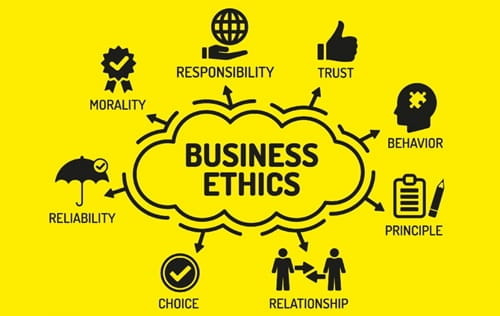
Business ethics sits at the intersection of two worlds that often seem to pull in opposite directions — the pursuit of profit and the demands of moral responsibility. It refers to the principles, values, and standards that govern how a business behaves toward its employees, customers, suppliers, competitors, and the broader society. In 2026, the relevance of business ethics has intensified significantly. Stakeholder scrutiny has never been higher, social media amplifies reputational failures globally within hours, investors increasingly factor ESG performance into valuations, and employees choose employers as much for their values as for their salary packages. Yet genuine dilemmas remain — ethical behaviour can impose real costs and create genuine competitive disadvantages in markets where rivals choose otherwise.
Advantages of Business Ethics
Enhanced Reputation and Long-Term Brand Value. A company that consistently demonstrates ethical behaviour — in how it treats employees, sources materials, prices its products, and handles mistakes — builds a brand identity that transcends its product offerings. Reputation, once established, becomes a powerful asset that generates customer trust, attracts premium talent, wins institutional clients, and enables premium pricing. In an age where a single whistleblower or investigative report can permanently damage decades of brand building, the reputational value of genuine ethical practice has never been more economically tangible.
Stronger Employee Retention and Engagement. People want to work for organisations whose values they respect. When a company operates with transparency, fairness, and genuine care for employee welfare, it creates an internal culture where people invest discretionary effort — they do more than the minimum because they feel part of something worth contributing to. This engagement translates directly into productivity, lower absenteeism, reduced turnover, and higher quality of work. The cost of replacing a skilled employee — recruitment, training, productivity loss during transition — is significant; ethical cultures reduce this cost systematically.
Investor Confidence and Access to Capital. Institutional investors, particularly those following ESG mandates, actively screen for governance quality, labour practices, environmental responsibility, and anti-corruption standards. A company with a documented ethical framework and consistent track record attracts this capital more easily, at lower cost, and with more patient long-term commitment than a company perceived as cutting ethical corners for short-term profit. In India’s growing ESG-linked investment universe, this access to preferential capital is becoming a structural financial advantage.
Legal and Regulatory Risk Mitigation. Ethical businesses are inherently less exposed to legal penalties, regulatory sanctions, and litigation costs. The financial consequences of bribery investigations, labour law violations, environmental breaches, and consumer protection failures can be catastrophic — legal fees, penalties, settlements, and the opportunity cost of management distraction during investigations. A culture of genuine ethical compliance reduces the probability of these events occurring in the first place, making it a form of risk management as much as a moral commitment.
Sustainable Long-Term Growth. Ethical businesses build relationships — with customers, suppliers, communities, and regulators — on a foundation of trust. Trust lowers transaction costs, reduces the friction in every commercial relationship, and creates the kind of loyalty that survives competitive challenges. While unethical companies may outperform in specific short-term situations, the weight of accumulated ethical debt — damaged relationships, regulatory hostility, talent flight, and reputational erosion — tends to compound into business underperformance over multi-year horizons.
Disadvantages of Business Ethics
Higher Operational Costs. Ethical business practices consistently cost more in the short run. Paying fair wages above the minimum, sourcing materials from certified ethical suppliers, maintaining environmentally responsible manufacturing processes, investing in worker safety beyond legal requirements — every one of these choices reduces immediate profitability. For small and medium businesses competing on price against rivals with fewer ethical constraints, these cost differences can be decisive.
Competitive Disadvantage in Low-Regulation Markets. When a business commits to ethical standards that its competitors ignore, it voluntarily accepts a structural disadvantage in the marketplace. In sectors where price is the primary purchase driver and where enforcement of labour, environmental, or safety standards is weak, the ethical company finds itself consistently undercut by rivals whose lower prices reflect lower ethical costs. This is not hypothetical — it is a daily operational reality for thousands of businesses operating in India’s informal economy adjacencies.
Slower and More Complex Decision-Making. Ethical decision-making requires considering multiple stakeholder interests simultaneously — shareholders, employees, customers, communities, future generations. This multi-stakeholder analysis is inherently more time-consuming than purely financial analysis, and it can create organisational paralysis when competing ethical obligations pull in genuinely different directions. In fast-moving markets where speed of decision is itself a competitive advantage, this complexity is a real operational cost.
Difficulty of Consistent Implementation. Establishing ethical policies at the leadership level is straightforward. Ensuring that those policies are consistently applied by every employee, contractor, supplier, and partner across every geography and function is enormously difficult. The gap between stated ethics and lived culture is where most business ethics failures actually occur — not in the policy documents but in the middle-management trade-offs made under competitive pressure and short-term performance targets.
FAQs
Q1. Is business ethics just about following the law?
A: No — business ethics goes beyond legal compliance. Many practices are technically legal but ethically questionable. Ethics addresses the quality of decision-making in the spaces where the law is silent or ambiguous.
Q2. Does ethical business always mean lower profits?
A: Not in the long run. The reputational, talent, regulatory, and relationship benefits of ethical business tend to more than offset the short-term cost disadvantages over multi-year horizons, though short-term trade-offs are real.
Q3. How can small businesses afford to be ethical?
A: Many ethical practices — transparency, fair treatment of employees, honest customer communication — cost nothing beyond management commitment. High-cost ethical practices like premium supply chain certification can be phased in as the business grows.
Q4. How does social media affect business ethics today?
A: It creates radical transparency. Unethical practices that previously remained internal knowledge are now a single employee post or customer video away from global visibility. This raises the effective cost of ethical failure dramatically.
Q5. What is the relationship between business ethics and ESG investing?
A: ESG investing — environmental, social, and governance — is the financial market’s mechanism for pricing ethical behaviour into company valuations. Businesses with strong ESG profiles attract more patient, lower-cost institutional capital.