Centralized vs decentralized crypto exchanges is the first real fork in the road for anyone buying or trading cryptocurrency, and the choice affects nearly everything about your trading experience — who holds your funds, what you can trade, how much you pay in fees, and which specific ways things can go wrong. Most experienced crypto users end up using both, but understanding exactly how they differ matters before you send your first transaction to either one.
| Quick Facts | Details |
| Centralized exchange (CEX) examples | Binance, Coinbase, OKX, Kraken, CoinDCX |
| Decentralized exchange (DEX) examples | Uniswap, Jupiter, PancakeSwap |
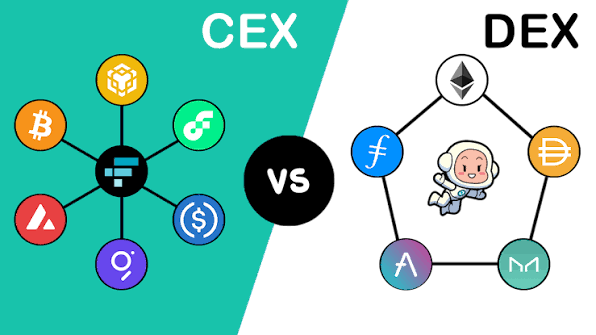
| Who holds your funds on a CEX | The exchange company, in accounts it controls |
| Who holds your funds on a DEX | You, in your own connected wallet, at all times |
| DEX monthly spot volume (January 2026) | Roughly $231 billion, up from ~$96 billion in January 2024 |
| DEX share of global spot trading (Jan 2026) | Roughly 13.6%, up from 6.9% two years earlier |
Here’s a practical detail that catches many beginners off guard: you cannot buy cryptocurrency with rupees or dollars directly on a decentralized exchange. DEXs only facilitate crypto-to-crypto swaps — to trade on one, you first need to buy crypto on a centralized exchange or fiat on-ramp, transfer it to your own wallet, and only then connect that wallet to a DEX. It’s a two-step process by design, not an oversight, and it’s the single most common source of confusion for anyone trying a DEX for the first time.
What Makes an Exchange “Centralized”?
A CEX operates the way most traditional financial platforms do, just applied to crypto.
- A single company or organization owns and operates the platform, controlling every aspect of how it functions
- The exchange holds custody of user funds directly, matching buy and sell orders through an internal, off-chain order book
- Users must complete KYC (identity verification) before trading, in compliance with regulatory requirements
- Fiat currency deposits and withdrawals — converting rupees to crypto and back — are a core function CEXs provide that DEXs cannot
- Asset listings are selective, since tokens must meet the exchange’s own compliance and quality standards before being added
What Makes an Exchange “Decentralized”?
A DEX operates on a fundamentally different model, removing the central intermediary entirely.
- Trades execute through smart contracts deployed directly on a blockchain, without any company holding custody of funds at any point
- Users connect their own wallet (MetaMask, Trust Wallet, Phantom) directly to the platform’s interface to trade
- Liquidity comes from pools that anyone can contribute to, rather than a centrally managed order book
- Listing a new token is permissionless — anyone can create a liquidity pool for virtually any token, without needing approval from a central authority
- This openness is a double-edged advantage: it enables immediate access to newly launched tokens, but also means scam and low-quality tokens can appear just as easily as legitimate ones
Custody: Who Actually Holds Your Funds
This distinction underpins nearly every other difference between the two models.
- On a CEX, your crypto sits in accounts the exchange controls — you’re trusting the company’s security and solvency with your assets
- On a DEX, your crypto never leaves your own wallet until the moment a trade actually executes, meaning you retain custody throughout
- This is the practical meaning behind the crypto phrase “not your keys, not your coins” — CEX balances are, functionally, an IOU from the exchange until you withdraw
- CEX collapses, most notably FTX’s 2022 implosion, demonstrated exactly what can go wrong when a centralized custodian fails or misuses customer funds
Comparing Fees, Speed, and Token Access
| Factor | Centralized Exchange (CEX) | Decentralized Exchange (DEX) |
| Typical trading fees | 0.02%-0.1% | ~0.3% swap fee plus network gas fees |
| Fiat on/off-ramp | Yes, direct INR/USD deposits and withdrawals | No — crypto-to-crypto swaps only |
| Token selection | Limited, subject to listing review | Broad, effectively any token with a liquidity pool |
| KYC requirement | Yes, mandatory | No, typically wallet-only access |
| Trade execution speed | Fast, centralized matching | Depends on blockchain network congestion |
Risk Profiles: Different Failure Modes
Rather than one model being universally safer, each carries genuinely distinct risks.
- CEX risks — exchange insolvency, internal mismanagement, regulatory freezes or shutdowns, and centralized hacking targeting the exchange’s own hot wallets
- DEX risks — smart contract exploits and bugs, MEV (maximal extractable value) extraction affecting trade execution, and cross-chain bridge vulnerabilities, which have historically been among the most exploited components in all of DeFi
- CEX security depends heavily on the specific company’s practices, insurance, and track record
- DEX security depends heavily on the underlying protocol’s code quality, audit history, and how established the specific platform is
- Neither model eliminates risk entirely — safety in 2026 depends more on the specific platform’s design, audit history, and custody standards than on which broad category it falls into
Regulatory and KYC Differences
This distinction matters particularly for Indian users navigating the country’s specific compliance framework.
- Centralized exchanges operating in India must register with FIU-IND under anti-money-laundering law and enforce mandatory KYC before allowing trading
- This registration requirement gives CEXs a clearer, more accountable regulatory footprint, but also means your identity is directly tied to your trading activity
- Decentralized exchanges, by their permissionless nature, generally don’t require KYC and are considerably harder for any single jurisdiction to directly regulate
- Regardless of which platform you use, India’s flat 30% tax under Section 115BBH applies identically to gains from both CEX and DEX trading — the tax obligation doesn’t change based on which type of exchange facilitated the trade
- The lack of built-in KYC on DEXs doesn’t exempt you from reporting requirements; the compliance burden simply shifts entirely onto the individual trader’s own record-keeping
Which One Should You Actually Use?
Rather than picking one exclusively, most experienced users deliberately use both for different purposes.
- Use a CEX for converting rupees to crypto and back, since DEXs simply can’t perform this function directly
- Use a CEX when trading high volumes or accessing advanced products like futures and margin trading with deeper liquidity
- Use a DEX when you want to maintain full custody of your assets without trusting a third party
- Use a DEX to access newly launched tokens not yet listed on major centralized platforms, while accepting the added risk that comes with permissionless listings
- Combining both — holding meaningful funds in self-custody while using a CEX for fiat conversion and high-liquidity trading — is a common, balanced approach among experienced traders
This is general educational information about exchange types, not investment advice. Both centralized and decentralized exchanges carry genuine, distinct risks, and independent research into a specific platform’s security track record is worth doing before depositing meaningful funds.
FAQs
Q1. Can I buy Bitcoin directly with rupees on a decentralized exchange?
No. DEXs only facilitate crypto-to-crypto swaps — you must first buy crypto on a centralized exchange or fiat on-ramp, then transfer it to your own wallet before trading on a DEX.
Q2. Is a decentralized exchange safer than a centralized one?
Not universally. CEXs carry insolvency and centralized hacking risk, while DEXs carry smart contract and bridge exploit risk — safety depends more on the specific platform than the broad category.
Q3. Do I need to complete KYC to use a decentralized exchange?
Generally no. DEXs typically require only a connected wallet, unlike CEXs, which mandate identity verification to comply with anti-money-laundering regulations.
Q4. Does trading on a DEX instead of a CEX change how much tax I owe in India?
No. India’s flat 30% tax under Section 115BBH applies identically to gains regardless of which type of exchange facilitated the trade.